.webp)
The Bedrock
420 Million Years In The Making
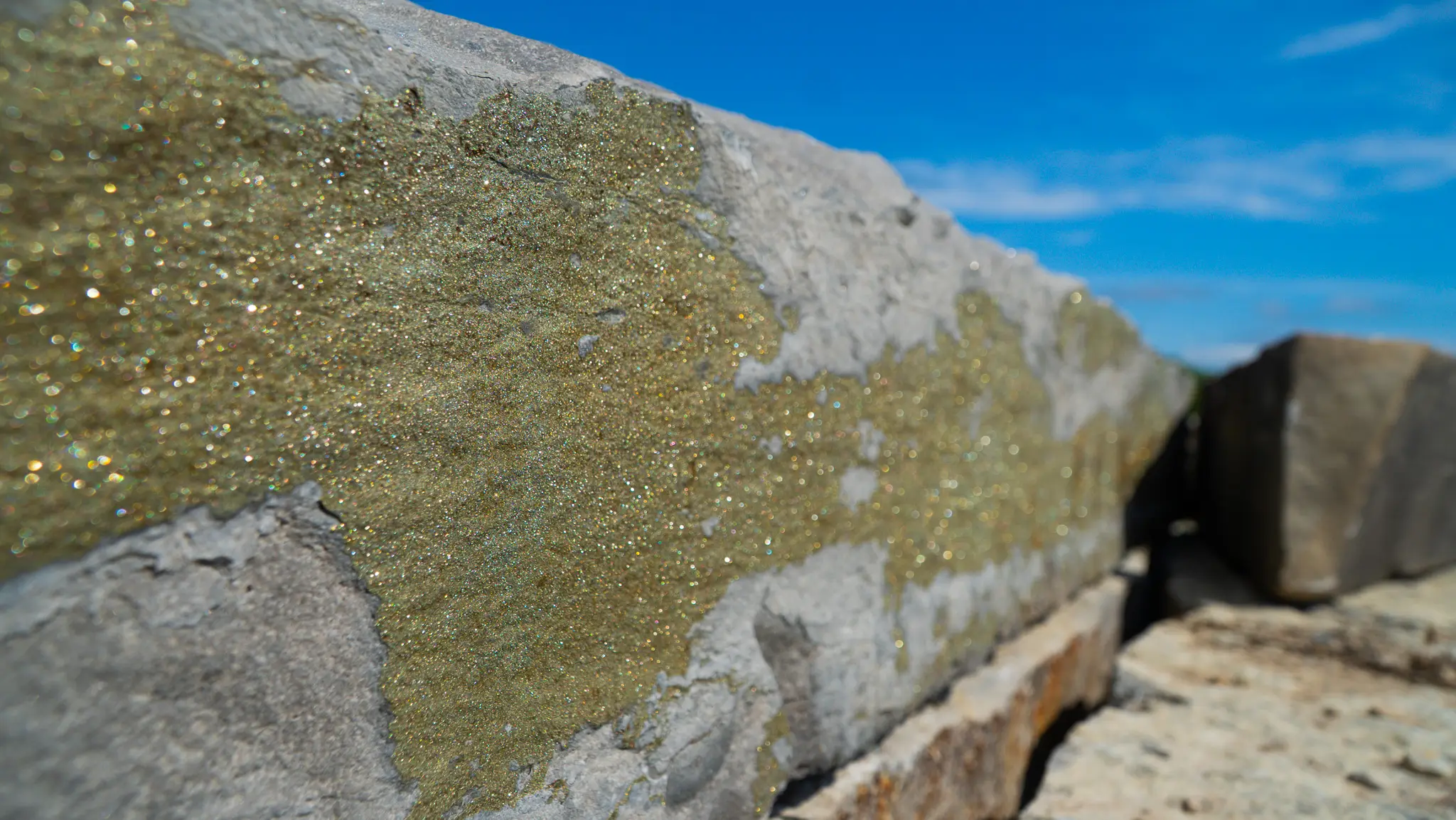
Every piece of stone we quarry began as ancient seabed — compressed, uplifted, and exposed along the same escarpment that carved Niagara Falls.
Geologic Time
Older Than The Dinosaurs
Our stone finished forming roughly 419 million years ago — about 175 million years before the first dinosaurs existed. On a timeline of Earth's full history, that puts it deep in what's called the Precambrian-to-Paleozoic transition: old enough that “recent” loses its meaning.
Full History — 4,600 Million Years Ago To Today
Zoomed — Last 500 Million Years
Both bars are plotted to true linear scale. Most of Earth's history — the Precambrian — is the unmarked span on the top bar; the bottom bar zooms into just the last 500 million years so the Silurian, the dinosaurs and modern humans can actually be told apart.
How It Formed
From Seabed To Bedrock
A Shallow Tropical Sea
In the Silurian Period, this part of the continent sat near the equator, submerged under a warm, shallow sea — nothing like the Ontario climate it sits in today.
Sediment & Reef Accumulation
Marine sediment, shell fragments and reef-building organisms settled on the seafloor, accumulating layer upon layer over millions of years.
Compression Into Rock
The growing weight of accumulating sediment compressed those layers into solid carbonate rock — limestone and dolostone.
Uplift & Exposure
Tectonic uplift and hundreds of millions of years of erosion exposed the rock as the Niagara Escarpment — the same formation Niagara Falls cuts through, running north through the Bruce Peninsula to Manitoulin Island.
Beneath The Surface
What We're Actually Quarrying
A simplified cross-section of the site — not to exact scale, but true to what sits beneath the surface here.
Topsoil & Vegetation
0–0.3m
Overburden
0.3–2m
Dolostone / Limestone Bedrock
2m+
Deeper Bedrock
Unquarried
Material Properties
Built For The Climate That Shaped It
Dolostone and limestone from this formation are dense, low-porosity carbonate rocks — part of why the same rock stands as towering cliffs at Niagara Falls and the bluffs of the Bruce Peninsula, still holding their shape after hundreds of millions of years of freeze-thaw cycling. It's the same durability that carries into every retaining wall, step and shoreline piece we cut from it.
Technical Documentation
Full Material Specifications
Detailed lab-tested specifications — density, compressive strength, absorption rate — are available on request for engineers and architects specifying our stone.
Request Technical DataSee The Result