
October 5, 2026
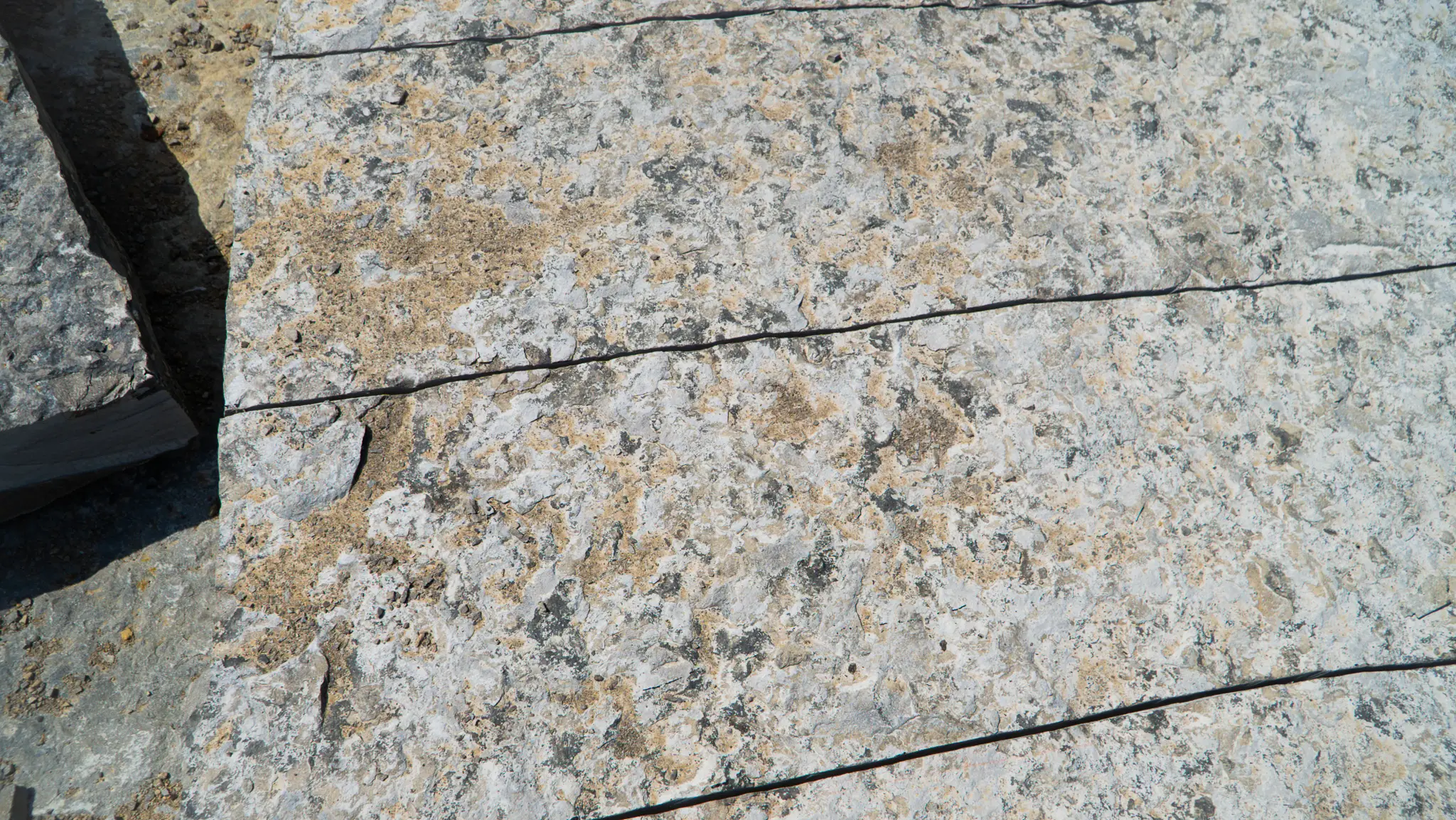
Stone is a sedimentary rock. The stone we quarry on Manitoulin Island began as marine sediment, shell fragments and reef material settling on a Silurian seafloor, layer upon layer, then compressed into solid carbonate rock. Those layers never fully disappear. They remain in the stone as bedding planes, the natural horizontal divisions that run through each bench of the quarry face.
Bedding is why stone behaves the way it does. Stone separates most readily along those planes, which is what gives flagstone its broad, relatively flat faces and lets thick beds be cut into steps and edging pieces with consistent depth. Cutting across the bedding is possible, but it takes more work and gives a different surface. Reading the bed before the saw touches it is a large part of getting a clean, usable piece.
It also matters after delivery. A step or a wall course that is set with its bedding running level is carrying load the way the stone was formed to carry it, and it sheds water and handles freeze-thaw better than a piece set on edge. If you are planning steps, flagstone or a wall, ask which way the bedding runs in the stone you are being offered. It is a simple question, and it tells you a lot about how the piece was selected.